

What if, tomorrow, a simple flexible suit were enough to reproduce all our movements in a virtual world? No more need for multiple rigid sensors on the body: our movements could be captured directly by a material capable of sensing its own deformations. This is precisely the path explored by researchers at the Massachusetts Institute of Technology (MIT) , who have just presented a particularly promising invention for virtual reality and video games.
Unveiled to the public on October 8, 2026, this technology takes the form of a second skin made of flexible silicone and optical fibers . Its unique feature? It can digitally reconstruct its own three-dimensional shape when bent, twisted, or deformed. All this happens almost in real time, without requiring an external camera to observe the surface.
Researchers are already considering several applications, including motion capture, medical rehabilitation, and the control of virtual characters. This opens the door to a new generation of VR accessories, even if we are still far from a commercial product.
A second skin capable of following movements in 3D
Today, body motion capture relies on various technologies: cameras, inertial measurement units, sensors placed on suits, or tracking systems integrated into VR headsets. These devices can be very effective, but they also have their limitations, particularly in terms of installation, size, or tracking different parts of the body.
The MIT team, composed of Qifan Yu, Nina Cao, and Kaitlyn Becker, devised a different approach. Rather than measuring only movements at certain points on the body, why not make an entire surface sensitive to its own deformations?
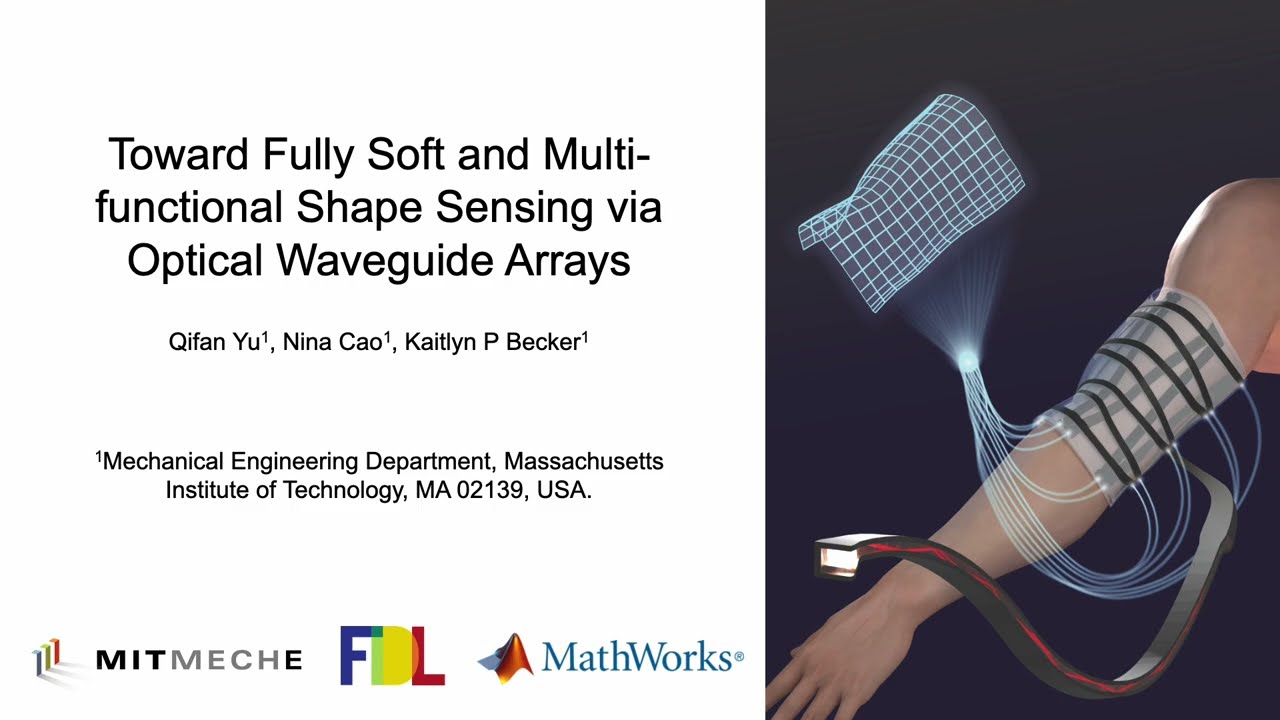
The result is a sheet of stretchable silicone through which several flexible optical fibers run, arranged in a zigzag pattern. When the material is deformed, the fibers also bend. These changes alter the light passing through them, allowing an algorithm to calculate the shape of the surface.
The ultimate goal would be to integrate this technology into a garment capable of conforming to the human body to follow its movements with more continuity than a simple series of point sensors.
How does this smart fiber optic skin work?
The principle relies on a well-known property of optical fibers: the light traveling through them can be affected by the curvature of the material. However, the researchers have made a particularly ingenious modification to their design.
Instead of using traditional glass fibers, they created optical guides from transparent rubber, surrounded by a layer of flexible black material. Part of the inner surface is intentionally roughened. Depending on the direction of curvature, the light is dispersed differently.
The system can therefore distinguish several directions of deformation, and not just measure the magnitude of a curvature.
Each fiber has an LED at one end and a light sensor at the other. The measurements are retrieved by an electronic circuit, then interpreted by an algorithm that reconstructs the three-dimensional geometry of the surface.
The experimental prototype uses 14 optical guides distributed across a 16 × 16 centimeter sheet that is 5 millimeters thick. When the researchers fold the sheet, its digital twin reproduces the changes in shape almost instantaneously.
A detailed approach is provided in the official MIT publication , accompanied by a video demonstration.
Accuracy to within a few millimeters and astonishing durability
One of the most interesting results concerns the accuracy of this new technology.
To evaluate their prototype, the researchers used several 3D printed molds, allowing them to compare the actual shape of the sheet with its digital reconstruction.
In the three configurations presented in their study, the average reconstruction errors reached 2,8 mm, 3,7 mm, and 4,5 mm , respectively . MIT indicates, for comparison, that some existing devices using rigid sensors exhibit errors on the order of 1 to 2 centimeters.
These results are encouraging, even if they do not yet constitute a direct comparison with all commercial motion capture systems. They primarily concern the reconstruction of an experimental surface.
Another impressive feature: the sheet continues to function despite the degradation of some fibers . The researchers created cuts and perforations that interrupt optical guides. Thanks to the redundancy of the collected information, the algorithm remains able to reconstruct the overall shape of the surface.
This resistance could be a significant advantage for future connected clothing, which is naturally exposed to friction and repeated movements.
A possible revolution for VR games and simulation
It is obviously in the realm of virtual reality that this discovery becomes particularly interesting for gamers.
Today, the most advanced VR headsets can track the head, hands, and sometimes the eyes. Some devices can also track the legs or pelvis with additional accessories. But continuously reproducing all body movements remains a complex task.
With clothing incorporating thousands of miniaturized flexible sensors, one could imagine a much more natural capture of gestures. A virtual avatar could theoretically reproduce arm flexions, torso movements, or certain deformations related to joints without requiring a multitude of rigid modules.
The potential applications extend far beyond traditional VR games.
In simulators, such technology could facilitate the reproduction of technical gestures, the manipulation of virtual controls, or training in mechanical interventions. For immersive multiplayer games, it could also improve the physical representation of avatars, particularly in social or role-playing experiences.
Gloves using similar fibers could eventually help to refine the capture of finger movements.
Of course, all of this remains speculative. MIT has not yet demonstrated a complete body-tracking system usable in a VR game. For the moment, it is an experimental sensing material whose capabilities will need to be validated on a larger scale.
To keep pace with these developments, the headsets themselves continue to evolve. We closely monitor new generations of hardware and their tracking technologies in our VR headset comparison tool.
The material can also detect pressure
The scientific study reveals another particularly interesting capability: optical fibers do not only react to the curvature of the material. They can also be sensitive to pressure exerted on their surface.
The researchers experimented with a mode that allowed them to locate pressure, achieving a spatial accuracy of approximately 1,5 centimeters in their tests. They also attached their sensor to a forearm and tested the measurement of wrist and elbow movements.
However, it is necessary to distinguish between two technologies that are often confused.
Detecting contact is not the same as reproducing the sensation of touch. The MIT prototype is not a haptic device capable of allowing its user to physically feel a virtual object.
Another current limitation: pressure detection and shape reconstruction rely on two distinct operating modes, which cannot yet be used simultaneously in this prototype.
There is still work to be done before we can consider a VR suit capable of both capturing all movements and managing physical interactions with a virtual environment.
A promising technology, but still far from our living rooms.
Despite these results, several obstacles still separate this invention from a truly mainstream VR accessory.
The optical fibers in the prototype are currently about 1 millimeter in diameter . The researchers plan to significantly reduce their thickness, potentially to a few tens of micrometers, in order to multiply the fibers in a much thinner textile surface.
It will also be necessary to miniaturize the electronics, integrate everything into comfortable clothing, and demonstrate that the reconstruction remains reliable when the body moves quickly or performs complex movements.
Compatibility with game engines, existing tracking systems, and the latency requirements of virtual reality will also need to be studied.
At this stage, no price, no release date, and no integration with a VR headset have been announced.
MIT is particularly highlighting medical applications. A sensor capable of precisely measuring changes in a patient's mobility could become a valuable tool for rehabilitation professionals, allowing them to compare movements performed over the course of sessions.
Towards virtual experiences where every gesture counts?
What makes this discovery fascinating is less the possibility of immediately replacing our VR controllers than the possibility of rethinking how we capture human movements.
Rather than attaching sensors to specific body parts, the idea is to transform a flexible surface into a true three-dimensional measuring instrument. This approach could find applications in simulators, robotics, medicine, and future immersive environments.
The technology is still in its early stages, but it is now based on a working prototype and published scientific results.
It remains to be seen whether this second skin will one day become a garment light, precise, and affordable enough to accompany our virtual reality sessions. And for simulation enthusiasts, the prospect of naturally reproducing every movement in a digital environment is truly captivating.
The work is detailed in the study Toward Fully Soft and Multifunctional Shape Sensing via Optical Waveguide Arrays , published in the scientific journal Advanced Intelligent Systems.


