
Modding is a culture that is clearly not unknown to the Farming Simulator universe. The Giants game can boast of being among the most modded games. But other games have very active communities as well. Just look at sites like Mod DB or Nexus Mods which host over 400.000 mods for around 1.800 games. There are several types of mods, although they could be classified into 2 main families: content mods and technical mods. For the latter, nVidia has just, in parallel with the announcement of the RTX 4000 series, to throw a stone into the pond with RTX Remix.
Graphics mods allow a game to survive over time, continuously improving its visuals year after year. And Nvidia engineers know how difficult it is to create graphics mods that directly impact a game engine. Game-specific tools must be invented to truly modify a game, and programming knowledge is often required to add modern effects. Some games are clearly not open to modding and don't even allow access to their files. We've seen a proliferation of ray tracing mods from the 3D chipset manufacturer's labs, such as the Quake II RTX mod , which took an entire team months to develop. Repeating this process to renew/refresh all older games is simply not feasible due to time constraints. Therefore, Nvidia has adopted a different approach.

NVIDIA RTX Remix comes into play
NVIDIA RTX Remix will launch soon, making it easier to remaster supported DirectX 8 and DirectX 9 games with fixed-function graphics pipelines . In a compatible game, pressing a hotkey captures the scene around the player.
RTX Remix is capable of capturing textures, geometry, lighting, and cameras using a custom and innovative D3D9 runtime called the RTX Remix Runtime . Classic games like Morrowind use the D3D9 runtime to send drawing calls (rendering instructions) to the GPU. The RTX Remix Runtime intercepts these drawing calls, interprets them, and reassembles them into an identical scene. From there, RTX Remix converts the assets and scene into the widely adopted Universal Scene Description (USD) open 3D framework , which forms the basis of the NVIDIA Omniverse platform.

Since RTX Remix is based on NVIDIA Omniverse, these USD game assets can easily be imported into the RTX Remix app, or any other Omniverse app or connector, including gaming industry standard apps such as Adobe Substance 3D Painter, Autodesk Maya, 3ds Max, Blender, SideFX Houdini and Unreal Engine from Epic Games.
Teams of modders can collaboratively upgrade and replace assets, and view each change, as the asset syncs from the Omniverse connector to the Remix viewport. This powerful workflow will change the way modding communities approach the games they modify, giving modders a single unified workflow, enabling the remastering of a diverse set of games without having to learn a multitude of proprietary tools.

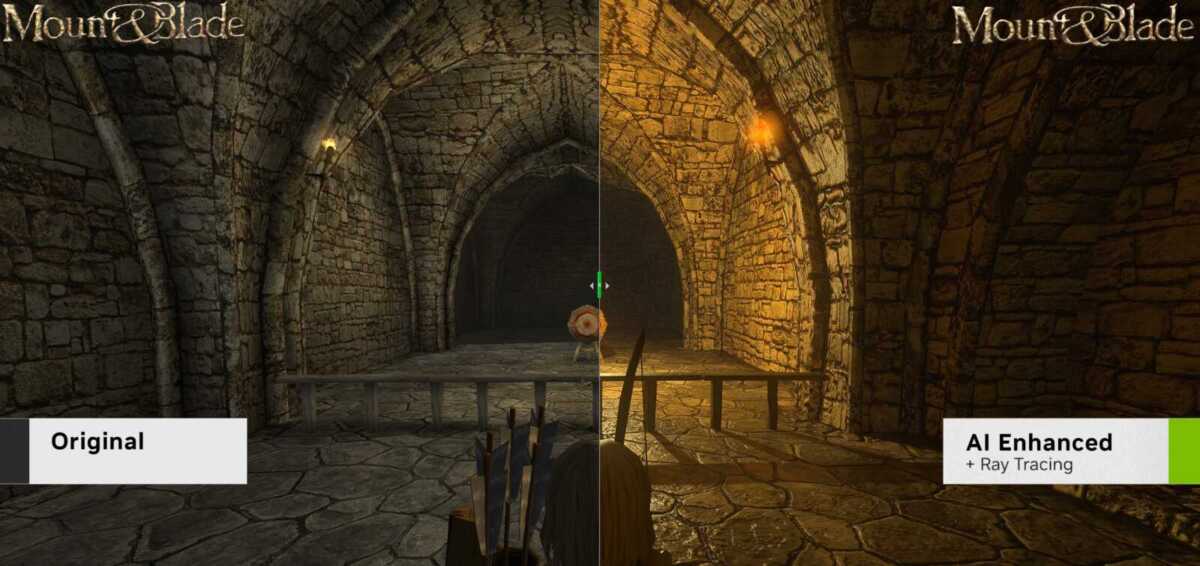
When remastering assets for use with ray tracing, every texture and surface requires physics-based rendering (PBR) materials, to allow them to interact naturally with ray tracing light. For example, glass reflects the world with clear details, while laminate flooring has rough and coarse reflections. And the stone, although without visible reflections, is still able to bounce light and have an effect on the scene. Classic games are usually built with simple color textures that lack any of these properties.
Beyond textures, your surfaces also need new details. To improve a classic game, a normal map is needed, or an entirely new surface with real geometric details that have been handcrafted by the modder, both of which take a little time to make.
RTX Remix simplifies and accelerates the art remastering process using AI. AI Super Resolution upscales extracted textures by up to 4x, transforming 1080p-class textures into higher-quality 4K assets. And AI Physically Based Materials analyzes the game environment to add PBR properties to all extracted assets. As the screenshots below from TaleWorlds Entertainment's Mount & Blade demonstrate, a paved floor instantly transforms from a flat surface with a basic texture into a detailed stone surface with a roughness map that interacts realistically with light.
In the image below from Bethesda Softworks' The Elder Scrolls III: Morrowind, NVIDIA artists used RTX Remix to remaster a scene. The team loaded an RTX Remix project shared through Omniverse, and when a member updated an object's material properties or an asset's mesh in Omniverse-connected apps like Substance or Maya, the scene of game synchronized in the Remix window: collaboration becomes child's play. A second artist could then spend their time in the Remix app, meticulously moving each completed item to its perfect position and relighting the scene with the reconstructed objects in mind. It's that simple, the tool allows for around-the-clock collaboration and development with a team of modders spread all over the planet. Previously, you had to wait for someone's work to be completed and submitted. Now there is no lag, and another can pick up where you left off.

A whole suite of production tools makes it possible to truly recast an old game into a new one.
Once the RTX Remix Mod is ready, simply export and share it with players. They just download the mod and place it in the game's directory next to the .exe file, then launch the game. The NVIDIA RTX Remix Runtime does the rest, replacing legacy APIs and rendering systems with the RTX Remix Runtime's 64-bit Vulkan rendering engine and upgrading visuals on the fly. Players also benefit from the instant addition of NVIDIA DLSS 3 for higher frame rates.
Example with Portal RTX, made using NVIDIA RTX Remix
Just like a real team of modders, NVIDIA developers have collaboratively created an amazing mod using RTX Remix. Every tool and process documented above was applied to create this DLC for Valve's game: PORTAL.

Can we dream of seeing Farming Simulator 15 using PBR textures, global lighting and raytracing? With nVidia RTX Remix, this becomes entirely possible.


